48 People Brushes Photoshop Procreate: A Practical Guide to Digital Figure Assets
In the evolving landscape of digital illustration and graphic design, efficiency often dictates the quality of workflow. For artists working in Adobe Photoshop or Procreate, the 48 People Brushes Photoshop Procreate collection represents a specific category of asset designed to accelerate the creation of human figures. Rather than drawing every silhouette from scratch, designers can utilize pre-made stamps that replicate the form, posture, and movement of people. This approach is particularly valuable for concept artists, urban planners, fashion illustrators, and hobbyists who need to populate scenes quickly without sacrificing anatomical plausibility.
Understanding whether this type of resource fits your creative toolkit requires a clear look at what these brushes offer, how they compare to traditional drawing methods or vector alternatives, and the technical considerations involved in their use. This article explores the utility of these digital assets, helping you determine if they align with your current project needs.
Understanding the Asset: What Are People Brushes?
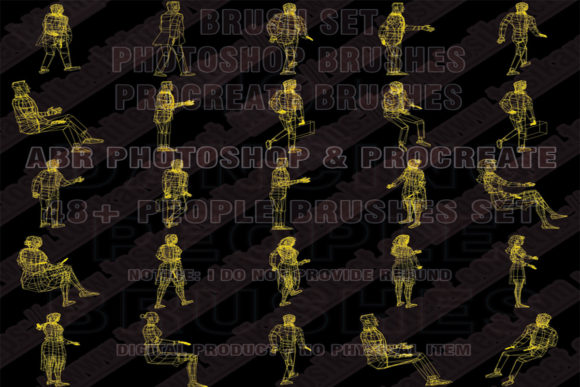
At their core, the 48 People Brushes are digital stamps formatted specifically for brush-based software. Unlike standard image files that must be imported, resized, and positioned manually, these assets function as dynamic tools within programs like Photoshop and Procreate. When you select a brush from this set, each click or stroke places a pre-rendered figure onto your canvas. The collection typically includes a variety of poses—walking, running, sitting, standing, and dancing—captured in silhouette or semi-detailed forms.
The distinct advantage of this format lies in its integration. Because they are loaded as .abr files for Photoshop or compatible imports for Procreate, they retain the flexibility of native tools. You can adjust opacity, flow, and size on the fly. Furthermore, since many of these brushes are created using advanced retouching techniques, the edges are often refined to blend naturally with digital paintings, avoiding the jagged or artificial look associated with lower-quality clip art.
It is important to note that this is a digital product delivered via instant download. The files are compressed in a .ZIP format, requiring users to extract the contents before installation. This process is standard for digital assets but may require basic file management skills for beginners. Once extracted, the user uploads the dancing people brushes or static figures into their preferred software library, making them immediately accessible for creative work.
Comparing Formats: Raster Brushes vs. Vector Silhouettes
When evaluating resources for human figures, creators often encounter a choice between raster brushes (like the 48 People Brushes Photoshop Procreate) and vector formats such as SVG, DXF, or EPS. Understanding the tradeoffs between these formats is crucial for selecting the right tool for your specific medium.
Raster Brushes (.abr, .png):
Raster-based brushes are pixel-based. They excel in environments where texture, lighting, and painterly effects are priorities. If you are creating a digital painting in Procreate or Photoshop, a raster brush allows you to paint figures that interact naturally with your brush strokes. You can easily change their color by adjusting layer properties or using clipping masks. However, raster images have resolution limits. Scaling them up significantly beyond their original size may result in pixelation or loss of clarity.
Vector Silhouettes (.svg, .dxf, .eps):
Conversely, vector files like SVG and DXF are mathematical representations of shapes. They are infinitely scalable without losing quality, making them ideal for large-format printing, logo design, or cutting machines (such as Cricut or Silhouette). If your goal is to create physical cutouts, vinyl decals, or laser-cut designs, the Silhouette Cut File or DXF options included in broader bundles are far more suitable than raster brushes. Vectors do not offer the same "painterly" feel and cannot be used directly as brushes in standard painting apps without conversion.
For many professionals, the ideal workflow involves having access to both. The 48 People Brushes serve the digital painting phase, while accompanying PNG or SVG files might be reserved for layout design or physical production. Evaluating your end goal—digital display versus physical fabrication—will determine which format provides the most value.
Use Cases and Best-Fit Scenarios
The utility of the 48 People Brushes Photoshop Procreate set varies depending on the industry and the specific project. Here are several scenarios where these assets prove particularly effective:
- Architectural Visualization: Architects and interior designers often need to add scale references to their renderings. Placing realistic human silhouettes helps clients understand the spatial relationships and size of a room or building facade. Using brushes allows for rapid iteration, enabling the designer to test different crowd densities quickly.
- Concept Art and Storyboarding: In early-stage concept development, speed is essential. Artists can use these brushes to block out character positions and crowd dynamics in a scene before committing to detailed line work. This helps in establishing composition and focal points without getting bogged down in anatomical details.
- Fashion Illustration: Fashion designers can use these figures as base templates to drape clothing designs. While specialized fashion croquis exist, general people brushes can provide diverse body types and dynamic poses that inspire new design directions.
- Graphic Design and Marketing: For social media graphics or web banners, adding human elements increases engagement. These brushes allow designers to populate backgrounds with subtle activity, adding life to otherwise static compositions.
However, there are limitations. If your project requires highly specific, unique character designs with precise facial features or custom anatomy, pre-made brushes may feel restrictive. In such cases, traditional drawing or 3D modeling might be more appropriate. These brushes are best viewed as time-saving tools for background characters, crowds, or quick sketches rather than replacements for primary character art.
Technical Considerations and Installation
To get the most out of the 48 People Brushes, users must understand the technical workflow. Since the files are delivered in a .ZIP archive, the first step is extraction. On Windows, this typically involves right-clicking the file and selecting "Extract All." On macOS, double-clicking the ZIP file usually unpacks it automatically. Inside, you will find the .abr file for Photoshop and potentially separate files for Procreate, along with other formats like PNG, DXF, EPS, DWG, PDF, and DOCX if included in the broader package.
For Photoshop Users:
Installing .abr files is straightforward. You can drag and drop the file directly into the Photoshop workspace, or go to Edit > Presets > Preset Manager and load the brush set. Once loaded, these brushes appear in your brush panel, ready for use. Remember that brush dynamics (such as size jitter or scattering) can be adjusted in the Brush Settings panel to create more natural-looking crowds.
For Procreate Users:
Procreate does not natively support .abr files in the same way Photoshop does. Users often need to import the individual PNG images as custom brushes or use a conversion method. Some bundles provide specific Procreate-compatible files. It is essential to check the included documentation or file list to ensure compatibility. If only PNGs are provided, you can import them as "Source" images for new brushes within the Procreate Brush Studio. This process allows you to customize the behavior of each figure, such as setting them to stamp mode rather than draw mode.
Making an Informed Decision
Choosing whether to invest time in learning and integrating the 48 People Brushes Photoshop Procreate depends on your workflow priorities. If you frequently find yourself spending hours drawing repetitive human figures for backgrounds or scale references, this tool offers a significant return on investment in terms of time saved. The variety of poses, including dynamic actions like dancing, adds versatility that static clip art lacks.
However, if your work primarily involves vector graphics, large-format printing, or highly customized character design, you may find limited utility in raster brushes. In those cases, focusing on high-quality vector libraries or 3D character models might be a better strategic choice. Additionally, consider your comfort level with file management and software customization. While the installation process is simple for experienced users, beginners may need to spend time learning how to import and adjust these assets effectively.
Ultimately, the 48 People Brushes represent a practical solution for a specific problem: the need for speed and consistency in depicting human forms. By understanding the differences between raster and vector formats, recognizing the best-use scenarios, and mastering the installation process, you can determine if this digital resource enhances your creative potential. As with any tool, its value is realized not just in its existence, but in how seamlessly it integrates into your unique artistic process.